
“The cannibals! You will be eaten by cannibals!” That was the warning John G. Paton received when he announced his call to take the gospel to the New Hebrides. An older man in his church—known simply as Mr. Dickson—tried to dissuade him. From a human standpoint, the concern was understandable. Paton’s ministry in Glasgow was thriving. Hundreds gathered each week, lives were being changed, and the work was fruitful. Why would anyone leave such a place?
The New Hebrides were known as one of the most dangerous mission fields in the world. Just nineteen years earlier, in 1839, missionaries John Williams and James Harris had landed there and were killed within hours. Their deaths were still fresh in the minds of many, and the opposition Paton faced came not from enemies of the gospel, but from concerned Christian friends. Reflecting on this moment, Paton later wrote, “The opposition was so strong from nearly all… that I was sorely tempted to question whether I was carrying out the Divine will… This also caused me much anxiety, and drove me close to God in prayer.”
Paton replied to Dickson’s warning: “Mr. Dickson, you are advanced in years now, and your own prospect is soon to be laid in the grave, there to be eaten by worms; I confess to you, that if I can but live and die serving and honoring the Lord Jesus, it will make no difference to me whether I am eaten by Cannibals or by worms; and in the Great Day my Resurrection body will rise as fair as yours in the likeness of our risen Redeemer.”
The danger was real, the opposition was understandable, and the cost was high—but Paton was convinced that Christ was worthy, even there.
When Paton arrived in the New Hebrides in 1858, the cost became immediate. Within weeks of landing on the island of Tanna, his wife, Mary, and their newborn son both died of fever. Paton buried them with his own hands and even slept on their grave to protect it. It would have been understandable for him to leave. Yet he did not abandon his calling. For over forty years, he labored among those islands, convinced that Christ was worthy and that even the hardest soil was not beyond the reach of God’s saving power.
Paton’s story did not end with his life. It helped fuel a missionary movement. The gospel did not stop in the New Hebrides; it continued to spread across the Pacific, eventually reaching places like Papua New Guinea, where the cost remained high and the danger real. Even today, the fruit of that gospel work remains.
Why would a man risk everything for such a mission?
Paton went because he believed Christ was worthy of whatever sacrifice it would cost to bring the gospel to those who had never heard—even at the risk of his own life.
Revelation 5:6–10 shows us why.
The Lion is a Lamb (v. 6)
Remember what the scroll represents. In Revelation 5:1–4, John’s attention turns to a scroll in the right hand of God—a scroll that contains His sovereign plan to judge evil, redeem His people, and restore all creation from the curse of sin. It is held securely by the One who rules history with perfect authority. Within it lies the full scope of redemptive history: God’s judgments, the vindication of suffering saints, the defeat of sin and death, and the final restoration of all things—including the new heaven and new earth. It holds both justice and hope—the outpouring of God’s wrath on evil and the fulfillment of His promises to save, dwell with, and rejoice over His people forever.
But as a mighty angel asks, “Who is worthy to open the scroll?”, a crisis unfolds. No one in heaven, on earth, or under the earth is found worthy, and John begins to weep. And rightly so—because if the scroll remains sealed, God’s promises go unfulfilled, sin goes undefeated, and redemption never reaches its goal. At that moment, everything hangs in the balance.
Then a voice breaks the silence: “Weep no more; behold, the Lion of the tribe of Judah has conquered” (v. 5). The answer is not found in human strength or angelic power, but in a person—the promised King, the fulfillment of every promise of God, the One who alone has the right to redeem.
And it is this Lion—this conquering King—that John turns to see.
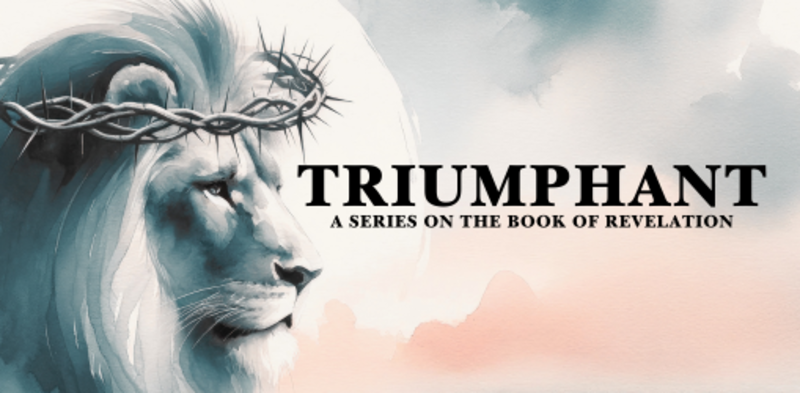
Yet when he turns, he is confronted with something utterly unexpected. Between the throne and the four living creatures stands a Lamb as though it had been slain. The promised Lion reveals Himself as the sacrificial Lamb of God. Victory has not come through crushing God’s enemies but through the crushing of the Son of God, who willingly and obediently went to the cross “like a lamb that is led to the slaughter” (Isa. 53:7), bearing the iniquities of sinners.
What John sees is not a contradiction but the key to everything. The Lion has conquered—but He has conquered as a Lamb. He stands triumphant, bearing the marks of the cross. John understood what this meant, and we must understand it as well: the One who is worthy is the One who has given Himself for you.
However, John not only sees a Lamb—he sees a Lamb with seven horns and seven eyes. In Scripture, horns symbolize power and kingship, and seven signifies divine completeness. This Lamb possesses perfect, sovereign authority. His seven eyes represent complete divine wisdom and perception, corresponding to the sevenfold Spirit of God sent out into all the earth. Nothing escapes His sight, and no judgment exceeds His wisdom.
These are not random details—they are a testimony. The One who stands at the center of the throne is not merely a symbol of sacrifice but the One of whom Jeremiah spoke: “Yahweh our Righteousness” (Jer. 23:6). He is the Lion of Judah, the Lamb who was slain, and the sovereign Lord over all.
Yet this is not all that John sees and experiences. The Lion who is a Lamb is also the Redeemer.
The Lamb is the Redeemer (vv. 7-8)
This Lamb is worthy not only because of who He is but also because of what He has done. The Lamb is the Redeemer. In the Old Testament, a kinsman-redeemer was a family member who could step in when everything had been lost. But not just anyone could serve as a redeemer—he had to be a close relative by blood, possess the resources necessary to redeem, and be willing to do so. That is why Boaz could redeem Ruth, yet Boaz was only a shadow of a greater Redeemer to come. Naomi had lost everything—her husband, her sons, and her security. The land that belonged to her family was in danger of being lost forever. But Boaz, as a relative, stepped in. He had the means and was willing. By marrying Ruth, he redeemed the land, restored the family, and provided an heir. What was lost was restored, and what was empty was made full.
But what humanity needed most was not merely the restoration of what was lost—we needed the reversal of the curse, reconciliation with the God we sinned against, and the renewal of all things. When Adam sinned, all was ruined—sin entered the world, death followed, and creation fell under the curse of his rebellion. What was needed was a true and better Redeemer—one who could stand in the place of fallen humanity and restore what had been lost.
This is what makes Jesus worthy to open the scroll. He became one of us so that He could be the Kinsman-Redeemer we need. He has the power to redeem because He is fully God. His willingness to redeem was demonstrated in that He embraced the cross, bearing our sin and becoming our curse. That is why, in Revelation 5, He steps forward and takes the scroll—because He alone meets every requirement. He alone is the Kinsman-Redeemer.
Through His incarnation, Jesus shares in our humanity. Through His divine Sonship, He possesses infinite authority as One equal with the Father. Through His willing sacrifice, He demonstrates beyond question His desire to redeem. The wounds of the Lamb are the proof of His willingness—and the scroll in His hand is the declaration of His worthiness.
Now, do not miss what happens in verse 8! Upon taking the scroll, the four living creatures—whose appearance represents the created order—fall before the Lamb in worship. The same creatures who, in the previous chapter, declared of the One on the throne, “Holy, holy, holy, is the Lord God Almighty, who was and is and is to come” (4:8) now fall before the Lamb to worship Him!
And if that were not enough, the twenty-four elders—representing the people of God in both the Old and New Testaments—also fall before the Lamb in worship. How do we know they worship Him? Because they serve Him—offering songs to Him and presenting the prayers of His people before Him. They fall before the Lamb because He is the One who stands as our High Priest. For all of Scripture testifies,
Since then we have a great high priest who has passed through the heavens, Jesus, the Son of God, let us hold fast our confession. For we do not have a high priest who is unable to sympathize with our weaknesses, but one who in every respect has been tempted as we are, yet without sin. Let us then with confidence draw near to the throne of grace, that we may receive mercy and find grace to help in time of need. (Heb. 4:14-16)
Do not miss the significance of this moment. In Exodus 20, God commands: “You shall not make for yourself an idol… You shall not bow down to them or worship them; for I, the LORD your God, am a jealous God…” (Exod. 20:4–5; BSB). Worship belongs to God alone. All of Scripture is clear—no created thing is worthy of worship.
Yet in Revelation 5, all creation—represented by the living creatures—falls before the Lamb. The elders fall before the Lamb. Heaven itself erupts in worship directed to the Lamb. What does this mean? It means the Lamb is not merely part of creation—He is the reason creation exists. The Lamb whom heaven worships is the One Scripture testifies to: “For by Him all things were created, in heaven and on earth, visible and invisible, whether thrones or dominions or rulers or authorities—all things were created through Him and for Him” (Col. 1:16).
The Lamb is not a created being—He is the Creator. And the worship given to Him is the worship that belongs to God alone!
The Redeemer is Worthy (vv. 9-10)
The moment the Lamb takes the scroll, heaven erupts in worship. Instantly, the four living creatures fall down in awe before the Lamb. The twenty-four elders—who had already surrendered their crowns before the throne—now bow in reverence, presenting the prayers of the saints as a fragrant offering to the Lamb. A new song breaks forth—not a song of anticipation, but of accomplishment:
“Worthy are you to take the scroll and to open its seals, for you were slain, and by your blood you ransomed people for God from every tribe and language and people and nation, and you have made them a kingdom and priests to our God, and they shall reign on the earth.” (vv. 9-10)
This is not a song of anticipation, but one of accomplishment! The Lamb is worthy because He was slain so that a people undeserving of the mercy of God could be ransomed for God. The Berean Standard Bible translates this verse this way: “Worthy are You to take the scroll and open its seals, because You were slain, and by Your blood You purchased for God those from every tribe and tongue and people and nation.” The Lamb is worthy because He alone can restore to redeemed humanity all that was lost through Adam, serving as the true and greater Adam who brings full restoration and hope to those He has saved.
Dear brothers and sisters, our worthy Redeemer did not stop there. Sinners are not merely rescued—they are restored. We are not only forgiven—we are brought near. You are not only saved—you are given purpose, identity, and a future. All who are redeemed by the Lamb have been made “a kingdom and priests to our God, and they shall reign on the earth.”
In this moment, all of heaven is united in awe. The question that brought John to tears finds its answer—not in an explanation, but in the person of Jesus. The scroll will be opened, history will unfold as God intends, and redemption will reach its glorious fulfillment. Jesus Christ—the Lion of Judah and the slain Lamb—is worthy to redeem, restore, and reign forever.
The question of heaven was asked: “Who is worthy to open the scroll and break its seals?”
And the answer is clear:
Jesus is worthy because He was slain.
Jesus is worthy because He has redeemed.
Jesus is worthy because He reigns.
So how do you turn your eyes from worthless things (Ps. 119:37)? You turn from what is worthless to the One who is worthy—not only of the worship of heaven, but of all of you. He is worthy of your attention. He is worthy of your obedience. He is worthy of your trust.
Some of you are clinging to things that cannot save, cannot redeem, and will not last. But there is One who was slain, who has redeemed, and who now reigns. He alone is worthy. So turn to Him. Trust Him. Worship Him. Follow Him.
One day every knee will bow before Him—so bow before Him now, while you still have time. Today is the day of salvation.

